

It’s the morning of March 22, 1820. Commodore Stephen Decatur Jr., top-ranking U.S. naval officer and acclaimed hero from the War of 1812, is riding out from his home in Lafayette Square, Washington, D.C., in a northeasterly direction. Destination: Bladensburg, a short hop across the D.C. border. He is about to participate in a duel he was challenged to by fellow senior naval officer, James Barron.
The two men have known each other for years. Bad blood has developed between them after Decatur participated in a court-martial proceeding against Barron that sanctioned Barron over his conduct in an 1807 skirmish with British naval forces. At 9 a.m., Decatur and Barron reunite one more time at the well-known Bladensburg dueling grounds, both brandishing pistols. A signal given, they pace the requisite eight yards before they both shoot. The bullets find their targets, and both men fall to the ground.
Reeling in pain, they face one another, and find some words of reconciliation. For Decatur, the situation is exceedingly grave. Rushed back to his home on Lafayette Square, he dies later that evening. In view of his rank and fame, Decatur is given one of the largest funerals the newly built capital has seen, attended by incumbent President James Monroe, Supreme Court justices, congressmembers and some 10,000 local residents.
Barron survives. While he continues his naval career and lives to old age, the incident indelibly tarnishes his reputation — a twist of irony given that Barron demanded the duel precisely to restore that good name.
Fast forward to 2026. Walkers, joggers and bikers regularly stop by the dueling grounds where Decatur met his fatal end. Situated near the popular Anacostia River Trail, the site falls within the boundaries of the Town of Colmar Manor.
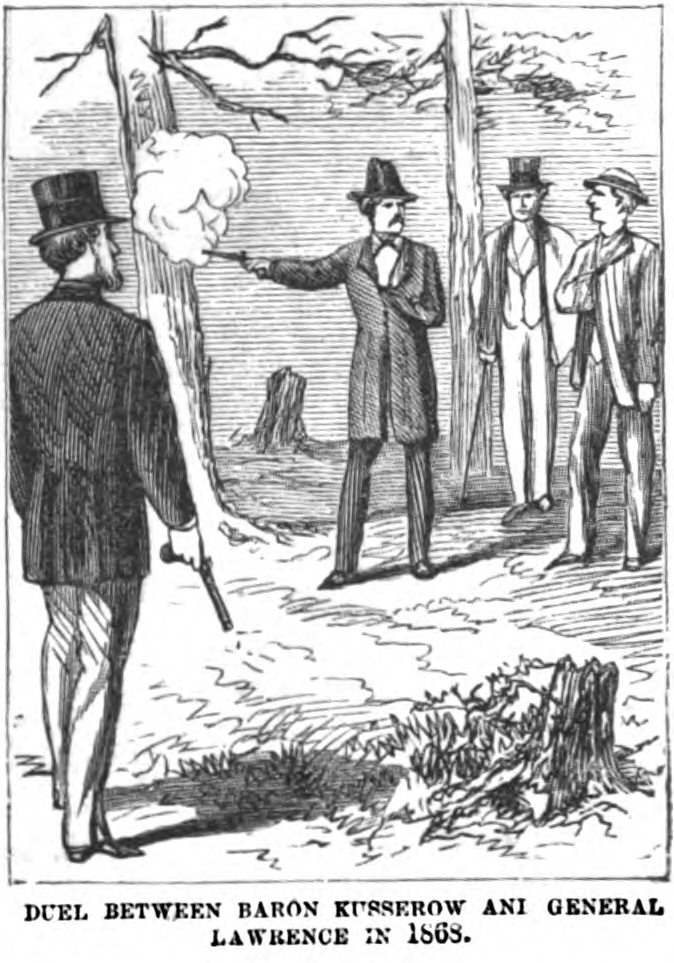
Two historical markers placed on the east side of Bladensburg Road — near the small bridge to Fort Lincoln Cemetery — give the site’s history: At least 26 duels are recorded to have occurred there, mainly in the early 1800s. One of the two panels was erected by the Maryland-National Capital Park and Planning Commission, the other by Anacostia Trails Heritage Area (ATHA), a nonprofit organization that manages the state heritage tourism area in Prince George’s County. (A third panel nearby provides the history of the Battle of Bladensburg, an important battle between British and American forces in the War of 1812.)
Thought to originate among European noblemen in the Middle Ages, the first recorded duel in the American colonies was in 1621 between Edward Doty and Edward Lester in the colony of Massachusetts. Probably the nation’s most famous duel took place in 1804, 16 years prior to the Decatur-Barron duel, between the first U.S. Treasury Secretary Alexander Hamilton and the second U.S. vice president, Aaron Burr. The Hamilton-Burr duel has been seared into popular memory recently by the award-winning Broadway show “Hamilton.” The two men — fierce political rivals with presidential ambitions and nationally renowned and accomplished figures — had their showdown in New Jersey, just across the Hudson River from Manhattan, to circumvent New York City’s ban on dueling.
Similarly, Bladensburg emerged as a dueling site because it lay just outside D.C., where dueling was banned. As duels grew increasingly violent in the 1800s, however, public sentiment more broadly turned against them. Congress banned dueling in 1839, but it would be two more decades before the practice went into irreversible decline.
For a more contemporary take on the grounds’ rich history, the Life & Times interviewed ATHA Executive Director Meagan Baco. “People were aware of the place for a very long time,” Baco said. “They had to be in a secluded area because this was where people settled disputes through violence.”
As to why the grounds have lingered in popular memory, Baco said, “We tend to have a morbid curiosity in dueling — a bit like how we love true crime podcasts today,” adding that historians have also tended to be interested in armed conflict.
Looking to the future, however, Baco is keen to start a new chapter. “I think we should move away from that focus. ATHA is currently reviewing the two panels. It’s not that the history itself has changed. But maybe the point we want to make, or the tone we want to strike in 2026 is not the same as before — even the same as it was 10 or 15 years ago.”
Hyattsville might see some changes on other local panels, as well. Baco says the review is part of a broader project, the first phase of which is to complete an inventory of the hundreds of signs that ATHA has erected across the county over the years. The nonprofit partners with local, state and federal governments and organizations to promote the county’s art, culture and history. One campaign, for example, to commemorate the war’s 200th anniversary, raised awareness of the often underappreciated role the 1814 Battle of Bladensburg played in the nation’s history: After British forces defeated the Americans in Bladensburg, they marched right into the District and burned down the White House and Capitol.
After completing the inventory, ATHA plans to make necessary repairs, while also reconsidering panels’ content. Stressing the multifaceted appeal of the dueling grounds for locals, Baco said, “There are many ways you can think about them: the environment — situated in a creek, the transportation, the Colmar Manor community. And, of course, what they say about person-to-person violence and conflict resolution. In our era, where we have extreme gun violence, having a sign that does not explicitly come out against that is something I’d like to change, and as soon as possible.”
This is the first in a series of articles highlighting important historical sites in and around Hyattsville.